What Was Saint Francis of Assisis Family Life Like
Nativity
Saint Francis was born Giovanni Bernadone in either 1181 or 1182 in the Italian hill boondocks of Assisi. His parents, Pietro and Pica, were 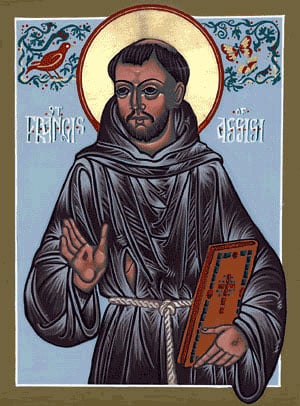 members of the rather well-to-do merchant class of the town. Pioetro Bernadone was abroad in France when his son was born. On his return, he had the male child's name inverse from Giovanni to Franceso ("The Little Frenchman"-perhaps a tribute to France, a land he loved and from which his wife'south family came). Saint Francis of Assisi, was born in 1182, more probably in the latter twelvemonth. His mother'southward family, which was non without distinction, may originally have hailed from Provence. His father, Pietro di Bernardone, was a prosperous textile merchant and one of the influential business men of Assisi. A merchant in those days was a far different individual from the modern shop keeper; forced by circumstances to be both daring and prudent, he constantly embarked upon the most hazardous undertakings and his career was likely to be a succession of ups and downs. Moreover, business organization activities, which today tend more than and more than to assert their independence of any upstanding code, were and so strictly subordinated to accustomed moral standards, as is clearly shown in the writings of Leo Battista Alberti, a century and a half later, or in the Summa Theologiae of Thomas Aquinas. Bernardone was not in Assisi when his son was born. At first the kid was called John but upon his father's return he was christened Francis, in retention of France, whence Pietro di Bernardone had but returned. More than any other character in history, St. Francis in after life retained the qualities most characteristic of babyhood, so that it is not difficult to imagine him every bit he must accept appeared during his early on years, with his combination of vivacity, petulance and charm.
Childhood
At the proper time immature Francesco Benardone was sent to clergy of San Giorgio, his parish church, to learn his letters and the ciphering necessary for a merchant. He sabbatum on a bench with the better-course boys, chorusing sacred Latin. He was non a brilliant student. The three extant scraps of his writing beguile a clumsy fist and abound in sad solecisms. In later years he avoided holding a pen; he preferred to dictate, and to sign his pronouncements with a cross or tau, a semisacred symbol. Yet, he learned enough Latin for his purposes, for schoolhouse routine and for the comprehension of the ritual. Francesco besides had the education of the home and store. He could admire his begetter, honest and worthy, simply an ascetic human, taking up where he laid not down, reaping where he had non shown. Drama also rendered his secret dream, the realization of the chivalrous life. The exploits of Charlemagne's paladins and the Knights of the Circular Table were already familiar throughout Italy, and lawmaking of knightly beliefs was known and honored, if little proficient. Francis's imagination disported itself in the enchanted earth of knighthood; and all his life he used the language of chivalry and appealed to its ethics. After Francis had attained manhood and developed his native discernment, he devoted himself to the profession of his male parent, who was a merchant. Nonetheless this he did in his own style. Merry and generous by nature, ever set up for jest and song, he roamed the town of Assisi twenty-four hours and night with his comrades and was almost prodigal in his spending-to such an extent that he used all the coin immune him and all his earnings for banquets and festivities. For this reason his parents oftentimes remonstrated with him, pointing out that he was living in such style with his friends that he no longer seemed to exist their son, but the son a great prince. Nonetheless as his parents were wealthy and loved their son tenderly, they allowed him to have his ain style rather that disturb him.
Educational Background
The official Life of Saint Francis, written past Saint Bonaventure, the Minister General of the Franciscan Order, after the chapter of 1266 at which it was decided that such a life was needed, because of the proliferation of apocryphal and spurious lives, records that Francis was sent to school to the priests of Saint George's, also in Assisi. But he seems to have learned little from them except enough Latin to read with difficulty and write great labor. In later life, the clerky Brother Leo normally acted equally his secretary; although an example of his signature survives, he preferred to make his marking with a Greek cross, the letter tau, the cross used by the crusaders. However, somewhere – probably in the first instance from his father and his father's business acquaintances – he learned enough French to exist able to converse in that language, and earn himself the nickname il Francesco, 'the Frenchman', although whether it was given to him by his father, as pious fable has always maintained, or by the wits of Assisi, is uncertain. Whoever gave information technology to him, information technology was the obvious proper noun for a boy wearing French cloth, talking with French visitors, and singing French tunes, the songs of troubadours and jongleurs. John Bernardone became ' Francis' early on in life, and has remained Francis throughout the years since. Which dialect of French he spoke is unknown. Because he was called 'the Frenchman' and called his language 'French', it is usually assumed that his dialect was that of the north and the Ile de France, non the langue d'oc of canton of Toulouse, which further due west towards Navarre shaded into early Castilian. But although he once himself proposed to go to Paris, most of the traces of 'French' influence in his life seem to relate to southern France, and there are no proofs that Pietro Bernardone'southward travels in search of business organization took him further due north than the great fairs at Toulouse, Lyons, and Montpellier. The Question remains open. Francis's everyday language must take been the electric current Umbrain dialect: not yet Italian, but a mingling of late Latin and dialect words from which Italian was rapidly emerging. He died merely thirty-nine years earlier the nativity of Dante, the first and greatest of the Italian vernacular poets.
Religious Affiliation and Experiences
In the chapel of Our Lady of the Angels, Francis was kneeling at the human foot of the crucifix, he was completely drawn out of himself and lost all consciousness except of God. From the cross Christ spoke to him. "Francis," the Voice came, "do y'all not see that My house is being destroyed? Go therefore and repair it." He took Christ's words in the nigh literal sense. He could meet that the neglected chapel was badly in need of restoration, so he accepted the task laid upon him as being simply that of bringing stones and mortar and setting to work. Not for an instant did he imagine that the commission could exist wider than that. Indeed, though the field of his labor was soon to widen to enclose the last limits of the earth, he never ceased to believe, as in the case of the lepers, that the local obligation was also his. He never ceased to be profoundly concerned about the rebuilding and care of battered churches.
Professional life
There is no doubt that Francis and his brothers did preach peace in Assisi in autumn, but whether in fact he played the leading part ascribed to him reconciling the factions is indemonstrable. If the merits also sometimes made is truthful, that it was from this time that he penitents of Assisi began to call themselves the frates minores, information technology is unlikely that Francis arbitrated effectually in the quarrel. At Assisi in 1202, frates minores would not have been taken to hateful 'the bottom', that is, more humble, 'brothers', but 'brothers of the minores'; it would have been a political label, every bit suggestive of delivery as 'the Workers' political party' of 'the workers' alliance' might be today. Francis had fought with the minores in 1202 and he was committed to poverty; but he had not damned the rich for their wealth, as Joachim of Flora had done, and it is unlikely that he would have begun his mission to the world by deliberately alienating a significant faction in his native city.
Major Goals
About the spring of the year 1206, Francis was freed from everything tying him to what theologians chosen 'the earth', Francis was poised to begin his life's piece of work at last. In that location was one difficulty, however. He nonetheless did non know what that piece of work was. Even though he was freed from the world, he was still totally dependent on it for food, drinkable and vesture. He took a job as a dishwasher in a monastery – probably a sub priory of the Benedictines of Mount Subasio – simply he felt that he was being badly treated there, and left, crossing the mountain to the hamlet of Gubbio, where an old friend took pity on him, giving him food and wearable. While Francis was working on the restoration of Saint Damian'due south, Francis besides continued his attempts to aid the lepers, who at this time were still outlawed and counted dead by most of the world. Since the first crusade, their numbers had vastly increased, though whether their disease was true leprosy or non is a matter of dispute. To rebuild Saint Domian'southward, he begged stones – and, of course, food – from his father's friends in Assisi. Their pity must accept been hard for Pietro Bernardone to bear as annihilation he had yet endured on Francis's account.
Major issues and concerns
During the Middle Ages, a number of movements were based on the ideal of poverty. What made the movement led past Saint Francis different was his attractive personality and passionate dedication to the message he preached. Ane of the almost popular of saints, he combined thrift with poetic gentleness. Francis popularized the custom of the Christmas crib. Too the three branches of the order that he established, many other religious societies bear his proper name. One of the major issues that Francis took an interest in the almost was, preaching the necessity of the poor, a unproblematic life-style based on the ideals of the Gospels. Francis overflowed with a spirit of dear non but for men who suffered but besides for dumb animals, reptiles, birds, and any other creature with and without consciousness. Above all, he loved little lambs with a special affection and love, for they showed forth the humility of our Lord Jesus Christ, since the Scriptures used the image of a lamb in describing him.
Major life events
When Blest Francis, accompanied by Blessed Peter of Cattaneo, who had been a doctor of law, crossed the ocean, he left behind two vicars, Brother Matthew of Nario and Blood brother Gregory of Naples. He instituted Matthew as vicar of St. Mary of Portiuncula; he was to remain there and accept postulants into the Order, while Gregory toured Italian republic to panel the bretthren. According to the first Rule, the fairs were as well fast on the quaternary and sixth day of the week. In that location might exist some plausibility in the proffer that the Roman authorities, while defective idealism themselves, shrewdly understood how to utilise the idealism of others, were it not that they would accept been imbecile in their policy had they failed to see that enthusiasm, to be useful at all, must be maintained. This actually ways that it must exist constantly renewed. Therefore information technology is absurd to suppose that they would take wished to modify the Franciscan idealism in such a fashion as to destroy or even diminish information technology. Theirs was the extremely delicate task of directing information technology so every bit to preserve it from dissipating its energies and to help information technology to go on the enthusiasm vivid and fresh.
What was this person most known for?
Saint Francis of Assisi was virtually known for all of his preaching. Francis began equally a poet and ended as one, though during the years of his active life he appears to have been too decorated living poetry to have felt much inclination to write it. Of Francis's own style of preaching we can say that information technology was birthday unstudied. He never prepared annihilation only, depending upon the inspiration of the moment, addressed himself with burning intensity to those before him. His whole body seemed to preach, and his gestures were vivacious and, perhaps, violent. Had information technology not been for his crystalline sincerity he might accept struck people as absurd. Probably, too, it was non only in the famous sermon he was soon to deliver earlier the Pope and the cardinals this his feet danced while he spoke. His great dark eyes, total of fire and tenderness, seemed to look each person present through and through. He had a vocalism so resonant that information technology was startling, coming from so frail a man. It was fortunate that he had that asset of the orator, for his physical presence was not at all impressive, and what slight advantages he might have had in this respect were thrown abroad considering of his appearing in a fibroid addiction patched with textile still coarser, sack-cloth that did not fifty-fifty friction match in colour.
Detail the search for truth
One mean solar day Francis, who had begun to walk about the house learning on a stick, thought the time had come for him to go and breathe the country air; he opened the door and went out , undoubtedly on to the road from Spello and Foligno, which was nearest to his house and near convenient for him, being almost level. The road runs along the side of Subasio: on the left ascent the curves of the broad mountain shoulder, here light-green with woods and there showing the bare rocks: on the right the ground slopes away gently, clothed in the compatible soft pallor of the olive. Before him, where the obviously stretches away to Foligno, green and fertile, cypresses and oaks strike a livelier not of colour. Of all the landscapes circular Assisi it is the sweetest and almost attractive. Francis, who had not looked at this view for a long time, sought anxiously for his usual sensations at the sight of it. But the mountains and the slopes, the apparently and cypresses and olives, had nothing more than to say to him; they were strange, inanimate objects.
What resistance was met?
The claims of his district has already drawn Francis towards the profession of arms, merely it was non enough to satisfy him. The disputes of a handful of paltry merchants and insignificant nobles over a business firm of the buying of a manufactory, the lilliputian wars of raids and rapine under the very city walls, made no appeal to him, subsequently his curt unlucky feel. Of the disputes between Church and Empire he understood merely little: he had a respect for ecclesiastical censure, for he had experienced in his own metropolis its blighting result on his religious life. He sought for far-away run a risk, a mighty war, without scruples of conscience, with much glory and the crown of nobility at the end of it.
How did he/she touch the globe around them?
All of the places that Francis visited, for example, Italian republic, according to the historical records, were many; and equally these appear in casual references, they can be only a office of the total. If we were to include the pop legends, the number would exist infinite. Terni, Perugia, ubbio, Citta` di Castello, Cortona, Arezzo, Siena, Florence, Bologna, Ancona, Osimo, Ascoli: these are as well some of the places that Saint Francis visited. Information technology is at in one case observable that they are all in a definite and rather confining district. The Saint'due south appearances in the more remote and various parts of the country, such as Rome, Florence, Bologna, and Alexandria, were, in proportion, few and far between; and one gets the impression (borne out by the definite or circumstantial evidence of the records) that these were but occasional visits. The other places, on the contrary, appear to represent his usual and appointed circuit. If you take a map of Italy and draw a circumvolve with Assisi as its center, with a diameter of a petty less than 2 hundred kilometers, you will include them all, from Borgo San Sepolcro to Ascoli Piceno, Rieti, and Toscanella, the extremist points being roughly equidistant from Assisi.
atteberyliblaingledy.blogspot.com
Source: https://schoolworkhelper.net/saint-francis-of-assisi-birth-life-religion-work/
0 Response to "What Was Saint Francis of Assisis Family Life Like"
Post a Comment