Lip Printed Duct Tape Art Falling in Reverse Drawings
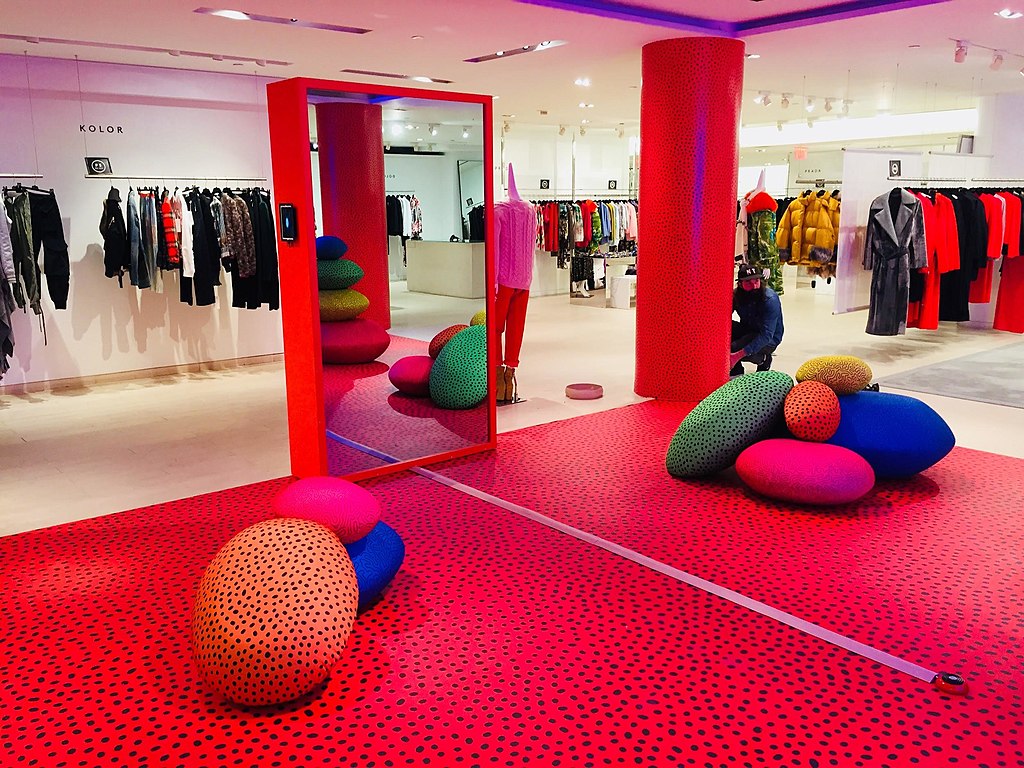
SPP Installation at Barneys, 2017. LICENSED UNDER CC0 1.0.
Floor LL
In 1923, Barney Pressman pawned his wife's engagement ring for five hundred dollars and opened a 5-hundred-square-foot article of clothing shop on Due west Seventeenth Street and Seventh Avenue, in downtown Manhattan, where he sold well-tailored menswear at steep discounts. He hung a sign over the doorway: NO BUNK, NO JUNK, NO IMITATIONS. Carelessness promise, all ye who enter here.
By the fourth dimension Barney retired, in 1975, the store was doing $35 million per year in business. Barney's son, Fred, added women'southward article of clothing, expanding the store into a row of town houses across the street. Nether Fred'south leadership, Barney'due south adopted a cool, upscale, whimsical vibe. Barney'south scaled upward—information technology was the starting time identify in America where you could buy Armani suits—still maintained a patina of accessibility through its legendary warehouse sales, where you could find Norma Kamali sleeping-bag coats in wacky colors at whacked-down prices. In 1981 Barney's became Barneys, discarding the apostrophe, becoming plural instead of possessive—the royal we.
In 1993, Barneys moved to a 230,000-square-foot French limestone palace on Madison Artery and Sixty-First Street, becoming the largest new store congenital in New York City since the Great Depression. At the opening night party, Barneys spent a quarter of a meg dollars on canapés. The Madison Artery flagship boasted ten circles of hell, from flooring LL to floor 9, which was dwelling to the eating house Freds. In that location were also secret floors: the mezzanine, a leatherbound couture clubhouse; the passage to the interior ballroom; the elevated jewelry section deep in the back of the first floor—beyond the Fendi baguettes and fur-covered pouchettes—where the real money began. Tourmaline, 20K gold, platinum-tinted locks.
The floors of Barneys form a fantasia in my heed, at in one case kaleidoscope and memory palace, a zoetrope that blurs my personal memories with something more collective. The section shop represents a glittery, glamorous, starry life that seems impossibly out of accomplish, yet information technology is also embedded in my Deoxyribonucleic acid; my grandparents endemic one in Atlantic City, New Jersey. Department stores feel similar a revolving door spinning constantly between who I am and who I imagine myself to be.
Floor LL—the Foundation—housed the Madison Avenue store'southward cosmetics department: foundation, golden-leaf face up cream in unbreakable jars, masks, brushes. It sold perfume—Frédéric Malle's Portrait of a Lady, Serge Lutens, Dior. When I was in my mid-twenties, I bought a Le Labo scent, Thé Noir, that was compounded for me correct in the store. While information technology was being distilled, I was able to design my ain custom label. "The thé," I wrote, after the catastrophe of Wallace Stevens's "The Homo on the Dump":
… Is it peace,
Is information technology a philosopher's honeymoon, one finds
On the dump? Is it to sit amid mattresses of the expressionless,
Bottles, pots, shoes and grass and murmuraptest eve:
Is it to hear the blatter of grackles and say
Invisible priest; is information technology to squirt, to pull
The twenty-four hour period to pieces and crystanza my rock?
Where was it one first heard of the truth? The the.
WINDOWS
Department-store windows are a spectacle. When you look in the window, you don't see into the storefront itself: you see a mode-fantasia aquarium depicting a scene, similar a diorama in a natural-history museum. Barneys's longtime artistic director, Simon Doonan, who joined the company equally a window dresser in 1986, made the store's windows iconically rebellious, a punk bizarrerie. Doonan put industrial tape on a nude statue of Madonna, spammed a rigorously minimalist Bottega Veneta mannequin display with dozens of Mr. Potato Head dolls, and dreamed upward Dominatrix Margaret Thatcher.
Doonan's flair marked him as the heir credible to one of the pioneering show-window dressers of the early 1900s: L. Frank Baum. Emerald Metropolis, the glittering jewel of Baum's Oz, is zippo if not a thou department shop, ane with shopwindows that are simply likewise dazzling for Dorothy's unjaded sight to conduct. "Many shops stood in the street, and Dorothy saw that everything in them was dark-green," Baum writes. "Green candy and green popular-corn were offered for sale, every bit well as green shoes, light-green hats, and light-green dress of all sorts. … Everyone seemed happy and contented and prosperous."
In addition to inventing Oz, Baum was too a pioneer in the then new art of creating elaborate shopwindows: his book on the field of study, The Art of Decorating Dry Appurtenances Windows and Interiors, was published at almost exactly the same time as The Wonderful Wizard of Oz. In 1900, a department store in Chicago advertised its new millinery collection using the "vanishing lady," a technology that Baum popularized: the acme half of the mannequin featured a hat, but the torso and legs periodically disappeared, reemerging in a new outfit. So many onlookers pressed against the drinking glass to sentinel the lady'south bottom half vanish that the store had to reinforce the windows with iron confined to keep them from peachy.
FLOOR One
Inside, through the revolving door, past the velvet rope and the Armani-armed security guard, the start flooring is Accessories. When you lot turn to the left, yous find sunglasses staring back at y'all: aviators; oversize; cat-eyed; centre-shaped Lolita spectacles. The lenses make up a wall of tiny convex mirrors in which you can meet yourself reflected back, slightly distended, in amber and green gray and polarized jet blackness. Dorothy's Emerald City is green because the Guardian of the Gate gives her light-green glasses to article of clothing: it's she, not the city, that projects the fantasy. Once, at Barneys, I went to an Oliver Peoples trunk show by accident and emerged with a rose-tinted pair.
By the sunglasses and to the correct are the purses, poised along the angled, backlit shelves, or slouching languid and liquid. The warm mahogany paneling creates a buttery background so that the leather glows—rich, sheeny, dimensional. Tiny follicles stud the ostrich leather, a firmament of vacant quills. Crisp accordion folds hide in the upright rectangles; gleaming aureate locks secure nothing. The bags are not only fantasies themselves, but in what they could incorporate.
In 1845, Henry West. Cross founded Mark Cantankerous, a leather-goods store in Boston that sold exquisite saddles. By the century's end, Marker Cross was located in New York, nether new ownership, and sold a lifestyle, offering purses and clothes aslope fine crystals, cocktail shakers, and Scottish golf game clubs. The heir to the Marker Cross make, Gerald Murphy, married the noted socialite Sara Wiborg, and they hobnob-hopped between the Riviera and the Hamptons. Picasso painted Sara. Hitchcock, another friend of the couple, asked Murphy for a very specific bag that Grace Kelly would carry in the 1954 motion picture Rear Window. On the outside, it'south nothing special—it resembles any box pocketbook with clean lines—just Kelly opens information technology for the big reveal: it's a cleverly designed overnighter, ready for a discreet rendezvous. It was afterward auctioned at Christie's, in 2002, with a colorful description:
LOT 28: GRACE KELLY 'MARK Cantankerous' Purse FROM "REAR WINDOW"
PARAMOUNT, 1954A blackness leather rectangular-shaped handbag used by Grace Kelly as she portrayed New York City girl-well-nigh-boondocks and socialite, Lisa Carol Fremont, in the Alfred Hitchcock classic. Used throughout the extended scene when Kelly arrives to scandalously spend the dark with Jeff, as portrayed by James Stewart…. Kelly calls it her 'Mark Cross overnight example,' Stewart asks if it'southward really a suitcase, Kelly opens it to display a negligee every bit she coyly says "Preview of coming attractions," Lieutenant Thomas J. Doyle, as portrayed past Wendell Corey, makes an innuendo nearly information technology and its purpose and lastly, Kelly naively asks if the Lieutenant thinks she's stolen information technology. … The electric current consignor's deceased female parent won this handbag in a contest shortly afterwards the flick was released in 1954, though the specifics are now not remembered by the family unit. 13 x 9 ½ x 3 inches.
Toll realized: 5,019 USD
In this way, Grace equally Lisa is Rear Window'due south true window brandish. James Stewart's Jeff might exist looking out the window, only the fantasia aquarium is happening from inside—Lisa highlights the Mark Cross bag every bit though she'due south in a Barneys window. I can just imagine the Simon Doonan tableau: a riff on Botticelli's Venus, with Lisa rising from the pale pink interior of a scallop. Lisa undoes the handbag's small gold clasp. The slim, difficult, blackness-leather shell springs open, and the interior spills forth: a silk negligee, Botticelli slinky, in vulva pinkish, and matching satin slippers nestled on pinnacle.
The purse'southward rosette burst is also the opposite of the garishly large zinnias cultivated past the murderer across the way from Jeff's flat. The negligee has been tucked in this rosette for hours, apparently, simply when Grace Kelly emerges from the bathroom, it clings to her supple form with nary a wrinkle, maybe she's built-in with it, no sign of age, so smooth that fifty-fifty crotchety Jeff is speechless. The negligee also has a capelet billowing out from around her shoulders. She never touches the floor.
In 2011, the in one case famous, then defunct handbag brand Mark Cross relaunched, phoenix luxe, returning to the same factories in Italy the company had ever used. After the company's revival, Marker Cantankerous released the Grace Small Leather Box Bag, a new version of the overnight case. At Barneys, it sold in a rainbow of cost points: navy blue, $2,395; python, $4,000; crocodile-stamped leather, $17,000.
FLOOR TWO
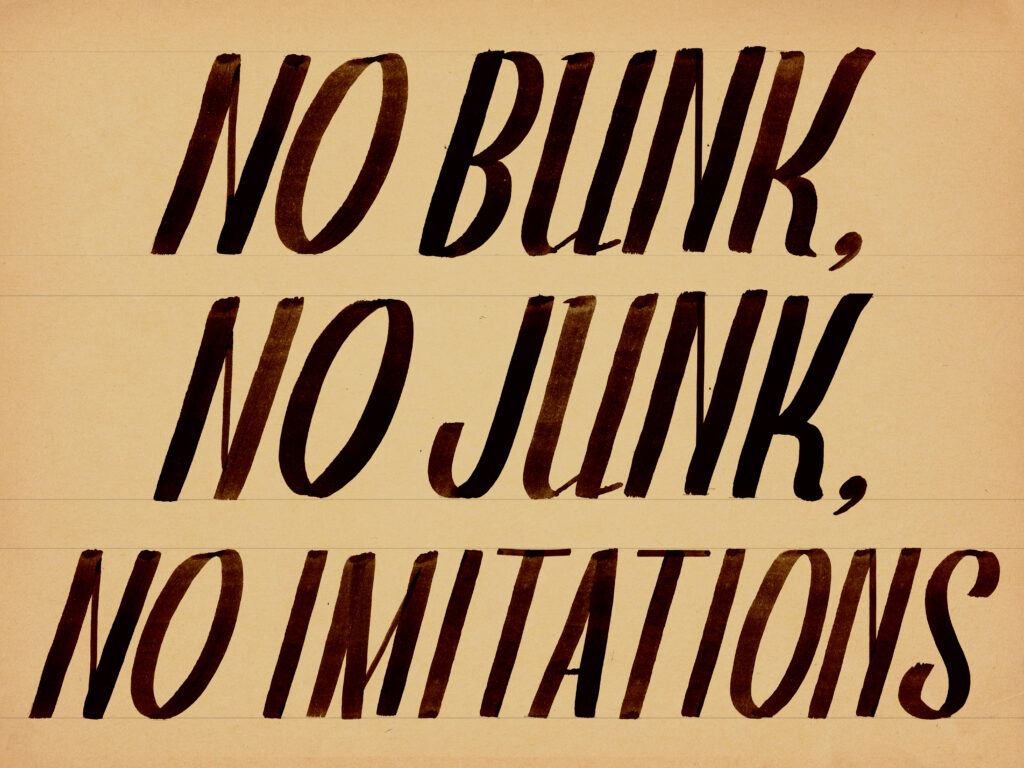
Illustration by Na Kim.
When Fred Pressman took over his male parent'due south store in the late 1950s, he brought what Simon Doonan dubbed a "cognoscenti grooviness" to the brand. At a "Decorated Denim" fundraiser for aids relief in 1986, glitterati strutted downwards a staircase in Levi's jackets custom-painted by artists such as Keith Haring and Jean-Michel Basquiat, which were and so auctioned for charity. Andy Warhol modeled Barneys clothes in their print ads.
Barneys ads were better than any other section store ads. Glenn O'Brien—a author known more often than not for being Andy Warhol'south practiced friend and for being at the eye of everything—gave Barneys'south impress ads a David Hockney meets 2nd generation New York School poets vibe, juxtaposing dry wit against smoothen paintings in bright pastel tones. One ad shows a curt-haired woman standing in front of a palm tree on a manicured lawn. Her eyes twitch down and to the left. Her lips are a shock of warm red. Her black silky jacket nips in at the natural waist and falls only below her hips, accentuating the curves of her wide-legged, impeccably white pants. And then, you notice the law car parked in the driveway. "Ruth had multiple personalities. They all had credit cards," reads the copy. Side by side to Ruth'south waist: "Ruth is wearing jacket and pants by Jil Sander. Makeup past Look."
One New Years' Day, my ex-best friend and I were in Manhattan, fugitive being ourselves. We dressed Uptown cool-girl in sweaters and skinny jeans, our hangover makeup smudging our eyelids. She brushed her hair into gleaming with a lacquered brush that would have turned my curly hair into a beehive, so twisted her shiny locks into perfect disarray, anchoring the knot with a Bic pen. Nosotros walked upward Madison and into Barneys and rode the countless glittering escalator—Escher Golden Barneys—stopping at every landing. Floor Two, designer women's article of clothing, was the only floor on the planet where everything, on this day of sales, was stubbornly total price. She plucked a pistachio-white leather jacket off the rack and handed it to me, where it glowed in my hands similar ivory, butter polish, illegal.
Miraculously, my card went through. That holiday season, Barneys had swapped its blackness bags for gilt ones that said BARNEYS XO, and I carried the golden ticket around all night, lovingly swaddled in tissue newspaper that was gristly enough to withstand heavy wind nonetheless so fragile information technology could rip at the touch of a stray fingernail.
FLOOR 3
"Two days earlier, nearly 11,000 English literature and modern-language professors had descended on midtown Manhattan for the start of the Modern Language Association'south almanac conference, the place where intellectual superstars like Stanley Fish, Elaine Scarry and Kwame Anthony Appiah share hotel space with hundreds of drastic Ph.D.'s interviewing for a meager handful of jobs. The jittery orgy of power, insecurity and angst is the other university's answer to the Cannes Film Festival, except that as these strivers fan beyond the city between standing-room-merely panels, instead of Anita Ekberg emerging from a fountain, they strain to take hold of a glimpse of aging Harvard nymph Marjorie Garber emerging from Barneys."
—Tom McGeveran and Rebecca Traister, "The Droves of Academe," The New York Observer, January six, 2003
When I moved to Cambridge, Massachusetts, to start a Ph.D. plan, my apartment was a third-floor walk-up studio, with a hallway bathroom that I shared with my lxxx-two-twelvemonth-old neighbour, who'd lived in her identical studio for decades. Dead bees would materialize in that flat with some regularity: 2 or three falling out of the lampshade when I turned the bedside lamp on, another two on the kitchen-surface area linoleum, a handful nether the radiator. An exterminator finally came; I vacated for a night, and when I came dorsum, one wall had been ripped out, replaced by a tarp sagging with insect husks.
"Did you lot know," the exterminator said, "that you had seventy thousand bees living in your walls?"
My closest concrete Barneys was in Back Bay, Boston—just a couple of miles across the river, but y'all might every bit well have needed a passport. Boston Barneys was Bad Barneys. The store was bi-level, the get-go floor mid-century opulent, in teak that looked cheap simply probably wasn't, dresses displayed on the walls every bit though in a gallery. The second floor wasn't quite right, either: also white and somehow both minimalist and punk. I used to buy things there with auction prices scrawled on the tags, spending too much coin on what I didn't really desire, and then walk back beyond the MIT span, which was 364.4 "smoots" long (the superlative of Oliver R. Smoot, a 1958 frat pledge, plus or minus one ear).
The decline and autumn of the glamor of academia and the heyday of the department store are deeply intertwined: they are cultural bastions of elitism, with rites of passage that involve family unit hierarchies, new dress, and the seasons, within which only a few ascension to the acme and certain departmental monoliths hold sway over the entire institution'southward cultural and financial well-being. The CUNY Graduate Middle had to inherit B. Altman's old footprint: there was no other heir for this deluxe shell.
To me, Barneys was another elite institution that beckoned me as it crumbled. Barneys was more than than a department store: it symbolized what it meant to exist a member of the elite. For my offset piece of paid journalism, I'd rented a car to drive to the suburbs and visit an American Girl store, then that I could write about these dolls that were marketed not as the historical characters that had made the brand famous, but as mini-me avatars: you lot weren't buying a piece of history, you were buying you lot. When the $250 check arrived, I had already, in true Sexual practice and the Metropolis way, pegged what I imagined to be the most glamorous matter that exactly that amount of money could buy: a Barneys New York–brand cashmere sweater, long, emerald green, with quilted-leather cuffs, that I imagined as my writer's uniform. I've never really worn information technology; information technology's attracted moths. But I know it'south there, waiting in the dorsum of my dresser, a holey talisman of a dream version of myself.
Flooring FOUR
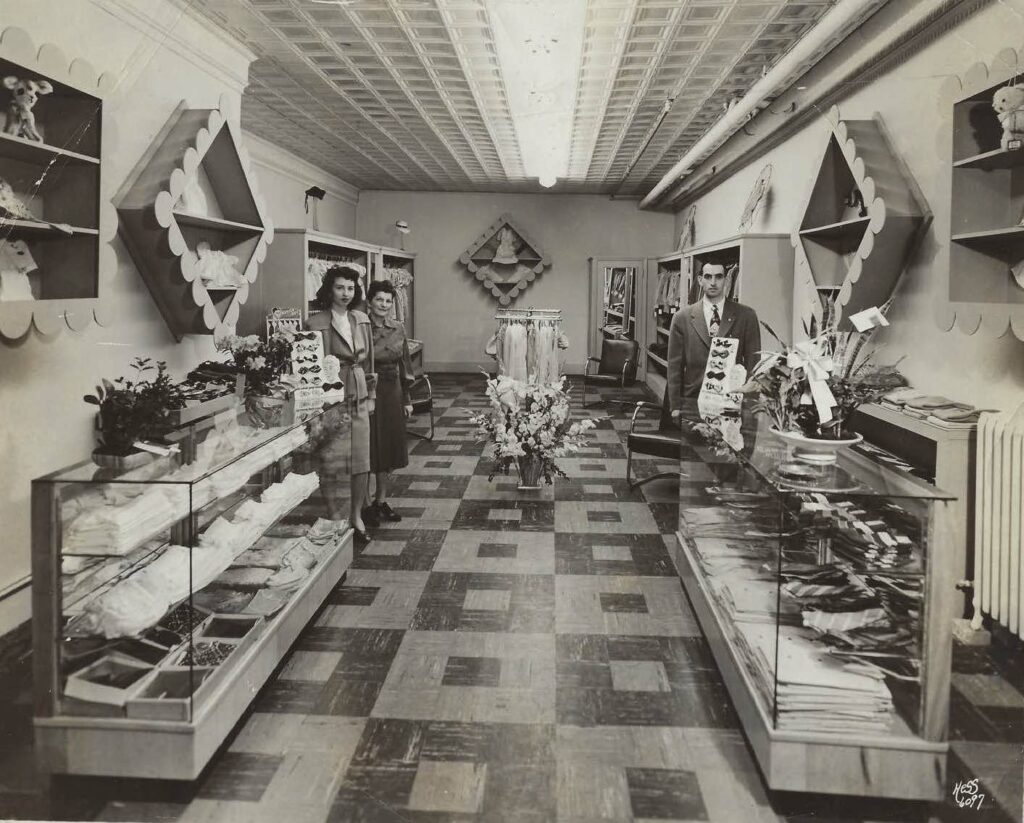
Gordon's Alley Department Store in Atlantic City. Photo courtesy of the writer.
When Barneys moved to its new Madison Avenue palace in 1993, the visitor abased its flagship storefront on Seventh and Seventeenth. The discount department-store chain Loehmann'south moved into function of that building; the Rubin Museum of Fine art took up residency in another. By 2014, Loehmann's was defunct; by 2016, Barneys had moved back, opening Barneys Downtown in the original Chelsea location. (The Rubin stayed put, and the old-new Barneys grew effectually information technology, the way Broadway bumps around 10th Avenue to brand room for a carmine tree.)
The all-time bathrooms in Manhattan were in Barneys Downtown. They were individual rooms the size of studio apartments, industrial-steel gray with persistently white sinks, and groovy light. I'd dream of hanging out with the mannequins in that location after hours, drinking Johnnie Walker Blackness Label at the McKittrick Hotel, where we'd see that immersive version of Macbeth, chosen Slumber No More. We'd follow the Weird Sisters into the basement and get into the bathroom with Lady Macbeth equally she washed blood over and over from her easily, to no avail.
Barneys Downtown was where I impulse bought a pair of em dash–shaped earrings. I paid $290, which was cheap, apparently, because they were sterling silvery and not white aureate. I take worn them nearly every day since, so, according to my calculations, later less than a year, they were paying me.
A glowing screw staircase, white every bit milk, wound its mode through the store—the Guggenheim, but make information technology mode. Manolo Blahniks perched on metal display stands bubbled up like filigreed fungi, their surfaces so lacquered that the stilettos mirrored themselves in the glass, the marble, and the gold.
That spiral staircase in Downtown Barneys was my Dna.
My granddad, my grandmother, her sister, and her sister's hubby founded Gordon's Aisle, a small department store in Atlantic City that became the first pedestrian mall in that metropolis. The business started equally Gordon's Youth Store, a children'south clothing store, because my dad, his sister, and their cousins were babies. Every bit the kids grew upwards, the store expanded to outfit them: Juniors and Teens, Menswear, Women's Wear.
I never knew my grandparents' section store—it closed when I was a baby. Barneys was Barneys but it was also connected somehow to Gordon'due south Alley, which I felt attached to as though information technology were my own.
FLOOR FIVE
My favorite Barneys was a surreptitious Barneys, the Barneys Co-op that existed on the Upper W Side for a tiny sliver of time. (They had to drop the Co-op from its name when the store got sued because it wasn't really a co-op—it was just co-opting the thought to seem cool.) The store was entirely street-level, but equally soon as you swirled in through the heavy crystal revolving door, you felt equally though y'all were underground, in a futuristic wine cellar. The shop was a single, infinite room, the walls pulsing bright white. Racks of clothes organized by designers—astral projections of aspirational life—shimmered as you approached and disappeared in your peripheral vision, hologram-thin. Isabel, Chloé, Alaïa, Rejina. I could be anyone.
When I was trying to escape myself in graduate school, I would invent reasons to go from Boston to New York. I once traveled four hours by train and twenty minutes by subway to take a 15-minute meeting, then floated west to Secret Barneys. A vest materialized before me, marled wool, Britomart meets Joan of Arc meets ski bunny. I bought it on the spot, then walked the forty blocks back to Penn Station because I didn't accept enough money on my Metrocard for the fare.
FLOOR SIX
In the nineties and early aughts, Barneys tried to leave New York. Chicago, Boston, Dallas, Philadelphia: ultimately, all failed expansions.
At the Beverly Hills shop, in June 2018, Barneys threw itself a political party to launch "thedropLA," an orgy of Barneys-exclusive collaborations. Each crossbred item got kissed with an "xo," the Barneys equivalent of the red heart in I ♥ NEW YORK. Manolo Blahnik, Fendi, Givenchy, Birkenstock, Dickies Construct, Cédric Charlier x Fruit of the Loom: Who in the fashion scene wasn't Frenching Barneys?
The party sprawled over two days and five floors, attracting musicians, actresses, designers, influencers, and non-influencers with deep pockets. For the party's crowning glory, Barneys installed a butterfly bar in its top-flooring jewelry section, arranging gemstones among the fauna. The live butterflies became trompe l'oeil: each time a butterfly rested on a co-operative, it as appeared to be jewelry until it fluttered abroad. The luckiest guests might go 1 to perch on a wrist for an Instagram instant.
Not all the butterflies launched according to programme. According to People for the Upstanding Treatment of Animals, expressionless and dying butterflies lay loosely around; others drifted outside, to unknown destinies. Barneys reported to peta that it would never again apply live animals in a display.
Ii years after, all the Barneys—Brooklyn, Boston, Chicago, Dallas, Los Angeles, Philadelphia, Seattle, New York, New York, New York, et cetera—were dead.
Floor Vii
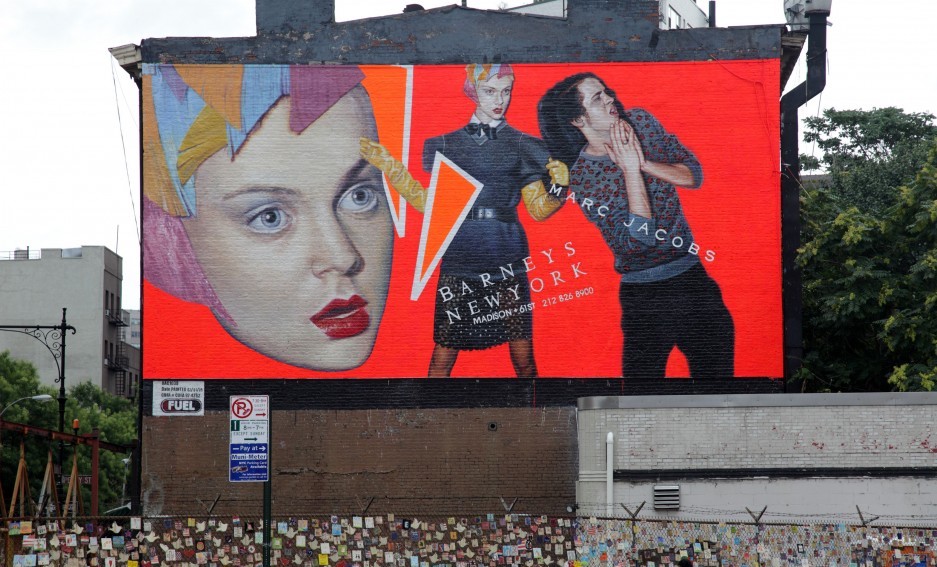
Barneys x Marc Jacob billboard designed past Scott Williams. Photograph courtesy of the artist.
Floors seven and eight were originally Barneys Co-op, but when the "Co-op" moniker had to go, they became a clunky penthouse suite they chosen "Contemporary," which meant that it felt like information technology was cheaper because it was streetwear, fifty-fifty if the sweatpants were still hundreds of dollars. Barneys within Barneys. Contemporary was an abridged version of the rest of the store: Women's, Men's, Jewelry, Accessories, Shoes, all compressed into two floors. Genes @ Barneys was the gimmicky café concept. I figured was because information technology was on the jeans floor—genius!—but it was actually named after Gene Pressman, a son of the original Barney. Gene was the Bad Barney: unlike Fred, who streamlined the Barneys zeitgeist, he led the charge to expand the brand, diluting the very air of inaccessibility that had made information technology cool.
The contemporary floors were a place I could pretend I was a version of myself who shopped at the real Barneys. I found a lawn tennis-brawl chartreuse Proenza Schouler satchel on such deep markdown that I couldn't afford non to get it. When the herbalist I'd been kissing that summertime invited me to his apartment in deep Brooklyn, I wasn't sure what was going to happen, only the satchel was modest plenty to expect similar a purse and big enough to hold my glasses, a toothbrush, and a change of underwear. The apartment was a seven-story walk-up, but he had pocket doors, and there were thousands of his herbal tinctures in perfect diamond bottles winking in the congenital-ins. He had roof access, and we started there. It was a hot nighttime. I lost a chip of a molar and my virginity.
FLOOR EIGHT
Cronos, the ancient Greek Titan, had heard the prophecy: he would be overthrown by his own child. Each fourth dimension Rhea, his wife, gave birth, he promptly swallowed the swaddled baby, reasoning that information technology could not undo him from within. Rhea obediently handed over the offset five children, merely when she had her sixth child, she smuggled an belly button—a stone—into the swaddling apparel for Cronos to swallow instead. She hid the baby, Zeus, who eventually did grow upwards, overthrow his father, retrieve his 5 siblings from Cronos's tum, and appoint them every bit his corulers on Mount Olympus, the glittering palace of these new gods.
Saks Fifth Avenue sucked upward the liquidated Barneys every bit though a milk shake through a straw .In November 2019, Saks partnered with the brand direction company Authentic Brands Group to acquire Barneys for $271 one thousand thousand. Equally part of the bargain, Saks sold Barneys'due south back inventory during the 2019–2020 holiday season, merely then rebooted Barneys as a mise en abyme : the department store had become a department inside another department store. Unlike Barneys, which both rose and flamed out because of its coolness, Saks was aspirational without attempting to be ineffable. Barneys belonged to the stars and the start-ups; Saks relied on its reliability, and on aspiration without losing accessibility.
By Jan 2021, floor five at the Saks 5th Avenue flagship had been reborn every bit Barneys "at" Saks, consummate with Barneys-branded tote bags. Information technology felt like the bad twin of Secret Barneys: all on 1 white, gleaming, but somehow smudged floor, all the guts splayed out in the open; no illusion, nothing special going on here anymore.
I wish Barneys hadn't been swallowed past Saks. I wish Barneys would disappear completely, so that information technology could ascension again, in mirroring glory. Who am I merely the version of myself surrounded by seventy thousand bees dying in my lamplight?
In And Just Like That…, the 2021 reboot of Sex and the City, Barneys has shuttered just is even so present. In one of the series's best and virtually poignant sight gags, Carrie carefully pulls the box containing Mr. Big'south ashes from the dorsum of her shoe collection, smooths out a wrinkled old Barneys New York shopping bag, and places Mr. Big inside.
FLOOR NINE
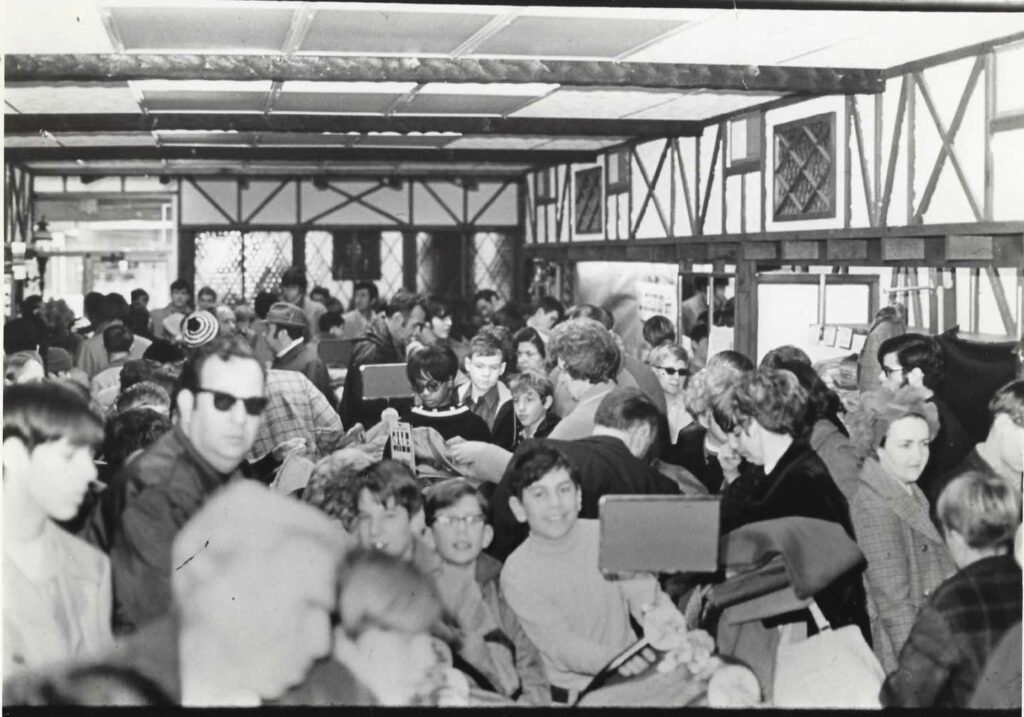
Gordon's Alley Department Store in Atlantic City. Photograph courtesy of the writer.
In January 2020, I made a pilgrimage to the flagship earlier it sank. Adept buys, then goodbyes.
LL was washed; the escalators didn't go down in that location.
First floor: junky sunglasses, xx of the aforementioned Valentinos with blood-red lenses.
There was this little handbag that looked like a tissue box—navy nacre with a beat out-pinkish handle, ivory silk inset. It was lovely. I turned information technology over in my easily, wondering if I should purchase it, and started carrying information technology beyond the floor to feel as though it were mine.
I carried information technology to floor two, where a little clique of headless mannequins blocked off access. Avant-garde, first to go.
The fur salon on tertiary was as dead as ever. You could stroke the minks.
Quaternary floor: menswear, no one cared.
Fifth floor: shoes, the Versailles mirrors peeled to the plywood. Two left-human foot shearling stilettos in 40 ½ European size were strewn across the fungal shag rug that had sprung up in the last few weeks, like an unkempt beard.
Sixth floor: contemporary, Tomorrowland, denuded.
On seventh I saw my nacre handbag, once again, and and then in contrary coloration, a shell-pink box with navy trim. The more times I saw information technology the more it became the kind of tissue box you'd find in the best Barneys bathroom, the kind someone else had refilled with actual Kleenex. My winter-chapped duke were apparently bleeding—in that location was blood on the bag. I left it for the sharks.
Eighth floor: the table in the changing room was on sale and so was the three-manner mirror, but the jeans were not. The women on eighth had been waiting weeks for the only macramé shawl. Somehow the walls had gone white to gray in days; they'd been secretly dyed the whole time. Please, Gott, I am an elderly adult female, said a woman at the counter. Have mercy.
On 9th, Freds was still reservation only, with lacquered wood, hushed lighting. But the eating house was an aquarium. The residuum was blasted out. Outside the dining room, the china was for auction.
Adrienne Raphel is the author of Thinking Inside the Box: Adventures with Crosswords and the Puzzling People Who Tin't Live Without Them. Her latest collection of poesy, Our Dark Academia, is forthcoming from Rescue Printing in autumn 2022. Her poem "Felix by Proxy" appears in the Spring issue of The Paris Review.
atteberyliblaingledy.blogspot.com
Source: https://www.theparisreview.org/blog/2022/04/27/barneys-fantasia/
0 Response to "Lip Printed Duct Tape Art Falling in Reverse Drawings"
Post a Comment